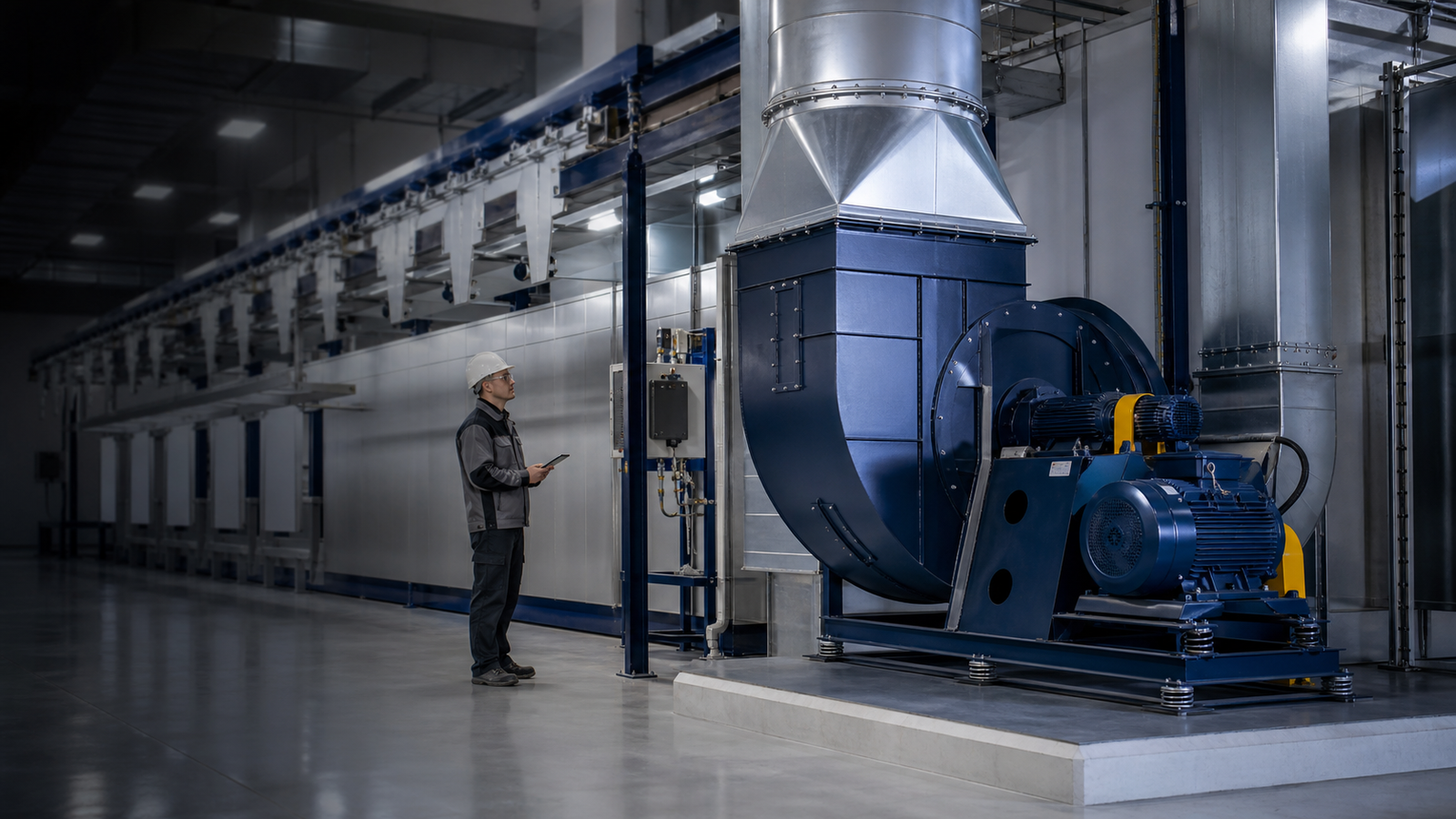
This project case outlines the planning approach for a process exhaust fan solution serving a coating line. The objective was to review the exhaust duty, working environment, connection constraints, electrical requirements, and delivery information before the equipment was released for production. The project is presented without customer-identifying details and focuses on the practical selection considerations relevant to similar industrial applications.
Project requirement
Coating and finishing operations may generate heat, vapour, odour, and airborne process contaminants that need to be moved through a controlled exhaust path. The project brief called for an industrial fan arrangement that could support the planned ventilation system while fitting the available installation space and connection layout.
Before recommending a product direction, the review focused on the target airflow, expected system resistance, duct route, discharge arrangement, air temperature, material compatibility, and operating pattern. These inputs are important because the correct fan is selected for the combined system duty, not only for a nominal airflow figure.
Process exhaust fan solution review
The proposed process exhaust fan solution considered a centrifugal fan configuration suitable for ducted air movement. Centrifugal fans are often evaluated for this type of application because they can be matched to a defined static-pressure requirement and integrated with ductwork, filters, dampers, or other system components where required.
Selection work included confirming the required duty point, identifying the preferred discharge direction, and reviewing the available space for the fan base, motor access, inlet connection, and maintenance. The rotation direction and electrical supply were recorded as part of the order review so the equipment could be prepared for the intended installation conditions.
Construction and environmental considerations
For a coating-line exhaust application, the working environment needs to be understood before finalizing construction details. The review considered the nature of the airstream, expected temperature, possible vapour exposure, cleaning requirements, and the need for an appropriate surface finish. These conditions influence material choices, coating requirements, access arrangements, and the inspection scope.
Where a project uses filtration or treatment equipment upstream or downstream of the fan, the additional resistance and maintenance arrangement should be reflected in the system review. The fan, ductwork, and any auxiliary equipment work together; a change to one part of the system can alter the required operating point.
Electrical and installation coordination
The electrical review covered voltage, frequency, phase, motor power, and the intended connection arrangement. For industrial projects, it is also useful to clarify the responsibility for field wiring, control equipment, isolation, and commissioning. Recording these requirements early helps the delivery team prepare the correct equipment identification and supporting documents.
Installation coordination also included the mounting base, connection dimensions, lifting access, service clearance, guard arrangement, and the direction of airflow. These details help the receiving team check that the delivered fan can be positioned and connected according to the planned layout.
Inspection and delivery preparation
Before shipment, the equipment is reviewed against the approved order information. Typical points include model identification, nameplate data, visible assembly condition, fasteners, protective finish, accessories, rotation-direction marking, and packing condition. The final scope depends on the agreed requirements for the order and should be confirmed before production rather than added at the last stage.
The delivery file can include the order confirmation, product specification, packing list, operating guidance, electrical information, drawings where agreed, and inspection records where required. Clear labels and a consistent order reference support receiving, warehouse handling, and installation preparation.
Key planning points for similar projects
A process exhaust fan solution is stronger when the buyer can share the duty point, duct layout, installation photographs, existing equipment information, electrical supply, process conditions, destination, and document requirements. This allows the selection review to focus on the actual application rather than a generic product comparison.
For coating, finishing, and other process-exhaust applications, the most useful early step is to define the airstream and system resistance clearly. With those conditions documented, the project team can review a suitable fan direction, construction approach, inspection scope, and delivery plan before production begins.