
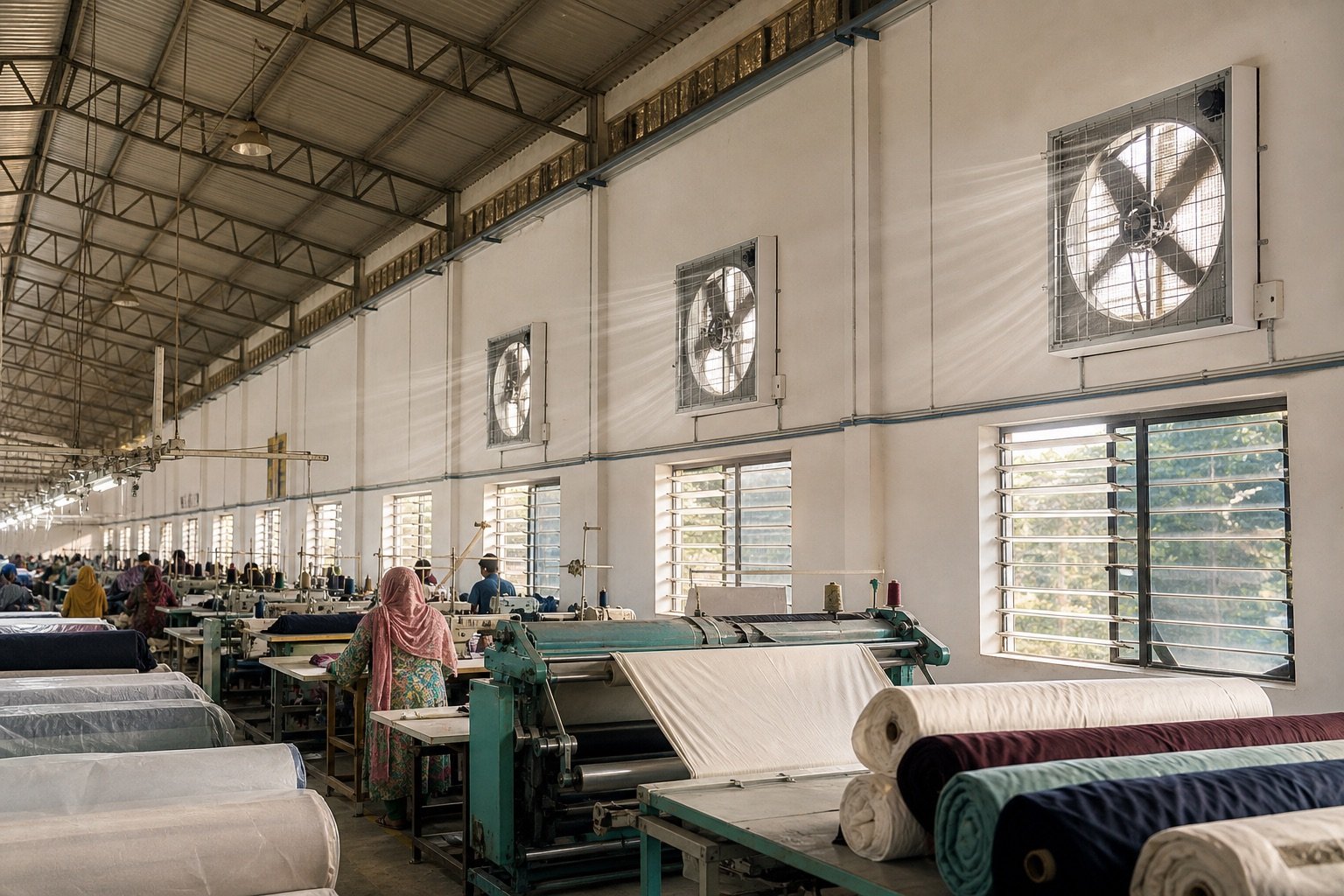
Textile factory ventilation was the central concern for this anonymous garment and fabric-processing project in Bangladesh. During the hottest and most humid production months, the customer’s high-roof workshop struggled to remove the heat, moisture, and suspended fibre generated by continuous equipment operation and a full workforce. Hengshuangda reviewed the site conditions and proposed a negative-pressure ventilation arrangement using JS series square exhaust fans to create a reliable whole-workshop airflow path.
Project background: a busy textile workshop in Bangladesh
The facility was a medium-to-large garment and fabric-processing workshop in South Asia, serving an order-driven production schedule. Fabric rolls were stored near the processing area, while sewing, finishing, and ironing activities added heat throughout the day. Bangladesh’s hot, humid climate made the indoor condition more difficult, especially in the afternoon when the roof space retained solar heat and the production lines were operating at full load.
The building already had several small wall fans, but they delivered air only near individual workstations. They could not create a consistent airflow route through the full workshop, and the warmest air remained trapped under the roof. Moisture, lint, and fine textile fibres also stayed in the occupied space longer than the customer wanted.
The ventilation problem and its production impact
The customer’s main issue was not simply a lack of air movement. The workshop needed to discharge the accumulated hot, humid upper-layer air and draw outdoor replacement air across the production floor. Without that exchange, workers experienced a heavy, stuffy environment during peak hours. Supervisors also reported that cleaning frequency was increasing because airborne fibre and dust were settling on nearby surfaces and equipment.
For a textile operation, indoor humidity and airflow influence more than comfort. Excessive moisture can complicate fabric handling and storage, while high heat can reduce the comfort and concentration of operators working repeated shifts. The customer wanted a practical upgrade that would improve the overall workshop environment without requiring a major structural rebuild or a complicated duct system.
How the customer found Hengshuangda
After comparing approaches for large-area workshop ventilation, the customer contacted Hengshuangda with site photographs, basic building dimensions, operating hours, and the location of existing openings. The project discussion focused on the airflow path rather than choosing a fan only by appearance. We reviewed where exhaust fans could be installed, how fresh air could enter from the opposite side of the building, and how the new equipment could work around the existing production layout.
This information allowed the team to recommend a textile factory ventilation solution based on negative pressure: exhaust at one side of the workshop, controlled natural air entry at the other, and an unobstructed flow route across the active production area.
JS series negative-pressure exhaust fan solution
The selected approach used JS series square negative-pressure exhaust fans mounted along the upper portion of one exterior wall. When operating, the fans create a lower-pressure zone inside the building and force the hot air, humidity, and suspended textile fibres outward. Fresh outdoor air then enters through openings on the opposite side, forming a through-flow instead of recirculating the same warm indoor air.
For the main exhaust positions, the project used the JS-II-10C belt-driven model. Each unit is rated at 0.75 kW with an airflow capacity of up to 32,000 m3/h. Its large airflow made it suitable for the main extraction duty in the broad production space. The belt-driven fan arrangement was paired with planned intake openings so the discharge side and inlet side could work as one ventilation system.
JS-II A-type fan options were also retained for areas with different space constraints. This series covers airflow capacities from 17,000 to 44,500 m3/h, allowing the final quantity and fan size to be adjusted according to workshop area, roof height, obstructions, and the required air-change strategy. A site-specific selection should always confirm the actual airflow route and intake area before final installation.
Installation logic and operating result
The installation placed the exhaust fans high on the wall to target the heat and moisture collected near the roof. Existing doors, windows, and planned louvered openings on the opposite side served as make-up air inlets. Keeping the inlet route clear was important: the fans can only exhaust effectively when replacement air has a sufficient, low-resistance path into the workshop.
After commissioning, the workshop had a more continuous air path from the intake side to the exhaust side. The project record showed an indoor temperature reduction of more than 4 degrees C during comparable operating periods, with humidity also falling as the trapped moist air was discharged. The result improved the perceived comfort in the work area and supported a cleaner, more manageable production environment.
Key points for similar textile factory ventilation projects
Every building has different dimensions, intake openings, production heat loads, and operating schedules. For a similar textile factory ventilation project, Hengshuangda recommends sharing a layout drawing or site photographs, workshop length and width, roof height, existing door and window locations, production equipment, electrical supply, and target installation positions. With those details, the required number of JS series fans and the most suitable model can be reviewed for the actual site.
By combining high-capacity negative-pressure exhaust with adequate natural make-up air, a textile workshop can replace trapped heat and humidity with a stable cross-building airflow. This Bangladesh project shows how a correctly planned JS series solution can turn local wall-fan circulation into a practical whole-facility ventilation system.