
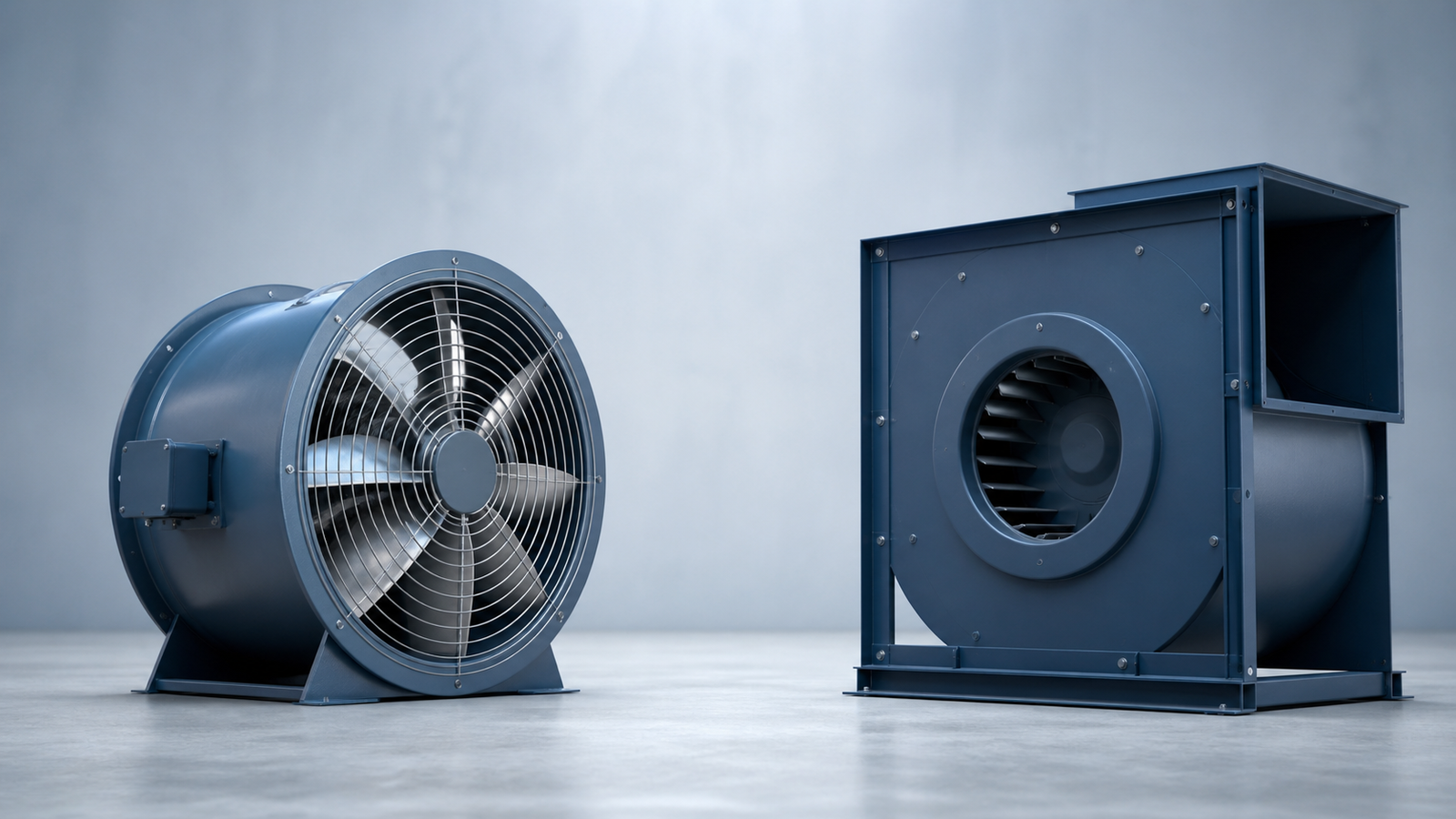
Axial and centrifugal fans can both move large volumes of air, but they respond very differently to system resistance. Choosing between them starts with the required operating point—not simply the fan diameter or motor power.
When an axial fan is the better starting point
Axial fans are commonly used for high-volume, relatively low-pressure duties such as workshop ventilation, wall exhaust, warehouse air exchange, equipment cooling, and short duct systems. Their compact airflow path can simplify installation where space is limited.
When a centrifugal fan is more suitable
Centrifugal fans are generally more appropriate when air must move through long ducts, filters, silencers, heat exchangers, collectors, or other resistance. Wheel design also allows configurations for clean air, dust, material handling, process heat, and higher-pressure duties.
Information needed for a useful comparison
- Required airflow and static or total pressure
- Duct layout and system resistance
- Temperature and airstream condition
- Installation space and discharge direction
- Noise limits, voltage, frequency, and operating hours
When pressure is unknown, provide the duct layout, filters, dampers, terminals, and intended installation. These details help establish whether an axial, mixed-flow, or centrifugal configuration is the safer direction.