
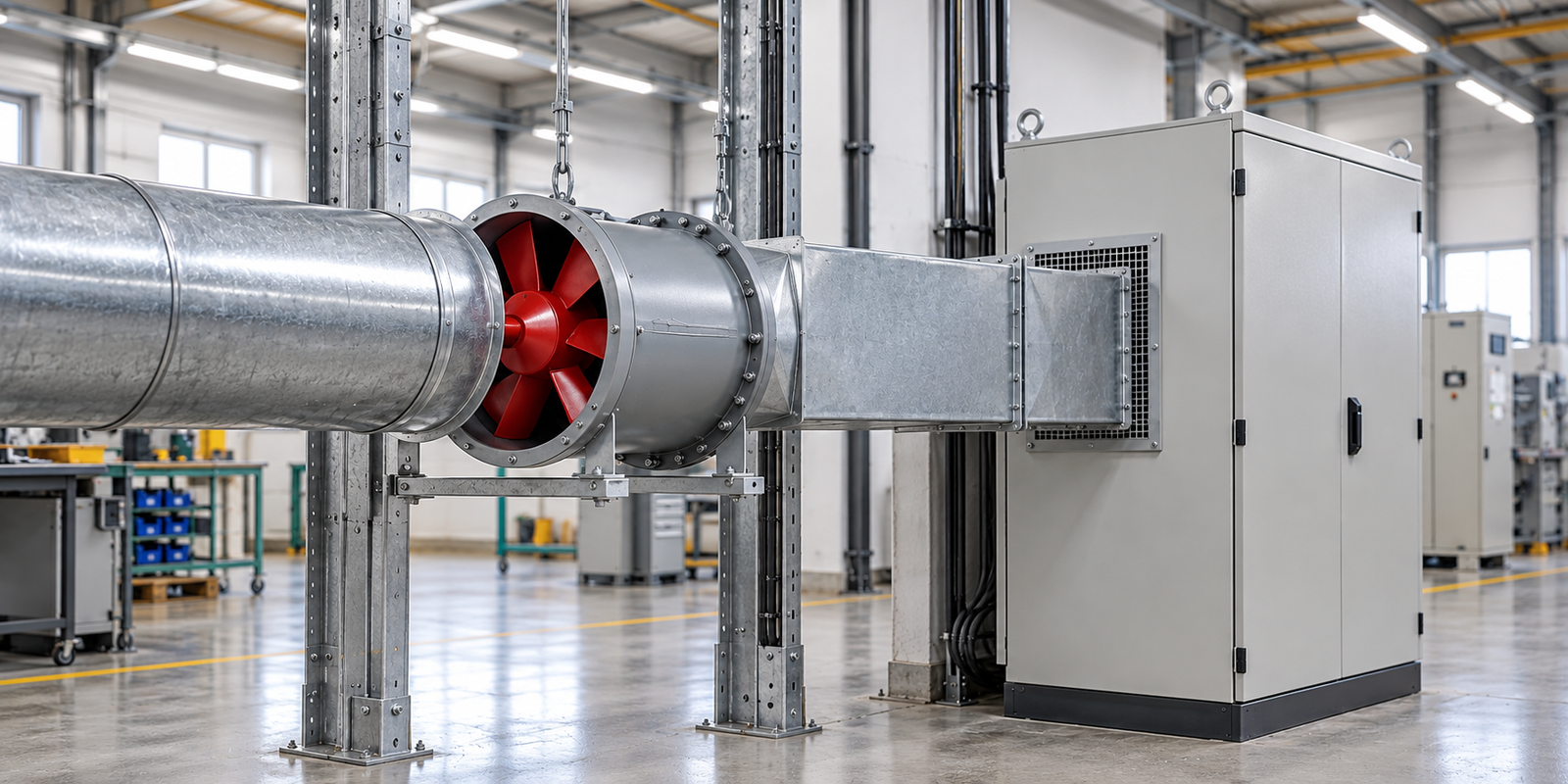
Axial fans for equipment cooling are often considered for motors, electrical enclosures, production equipment, and other heat-generating machinery. They can move a high volume of air through a relatively open path, but adding a fan alone does not guarantee a lower equipment temperature. The result depends on where the air enters, how it passes the heat source, and where the warmed air goes.
This guide explains how to plan an axial-fan airflow path for equipment cooling, what to check before installation, and how to verify the result under normal operating conditions.
1. Define the cooling problem before choosing a fan
Start with the equipment that is overheating or needs additional cooling. Record its normal and peak operating conditions, the surrounding air temperature, the locations where heat builds up, and any manufacturer limits for temperature or ventilation. Check whether the issue is caused by a blocked intake, dirty filter, failed existing fan, recirculated warm air, or a process load that has changed.
Separate the equipment’s heat-removal need from general room comfort. A fan that makes a work area feel breezier may not direct enough air through the equipment’s intended intake and exhaust openings. For enclosed equipment, follow the enclosure or machine manufacturer’s ventilation instructions and preserve required clearances.
2. Plan a complete path for cool air and warm exhaust
Map the route from the air source to the equipment and from the equipment to the discharge point. Cool replacement air should reach the intended intake, pass the heat-producing area, and leave without returning immediately to the fan inlet. If supply and exhaust openings are close together, or if an outlet points toward the inlet, warm air can short-circuit back into the system.
Look for nearby walls, beams, stored materials, partitions, and other machines that may block the inlet or redirect the discharge. Keep the fan inlet and outlet clear according to the product instructions. Where ductwork is used, review bends, transitions, guards, filters, and discharge openings as part of the full airflow path rather than evaluating the fan in isolation.
3. Match the axial fan to the system resistance
An axial fan is commonly considered for high-volume air movement in a comparatively low-resistance path. Actual suitability depends on the selected model and its performance data. Duct length, elbows, screens, filters, dampers, and restrictive openings add resistance and can reduce the airflow delivered in the installed system.
Compare the required airflow and pressure with the performance data for the exact fan configuration. Do not select by diameter or motor power alone, and do not assume the catalog maximum airflow will be available after installation. If the air path has substantial resistance, ask the supplier or a qualified engineer to compare appropriate fan types and configurations.
In its industrial fan guidance, the U.S. Department of Energy recommends uniform airflow before a fan inlet and after its outlet. Its fan-system sourcebook explains that a nearby bend can create uneven inlet flow and system effects. Where space is limited, have the layout reviewed against the fan manufacturer’s guidance rather than applying a generic clearance as a universal rule.
4. Check the product, mounting, and site conditions
Confirm the chosen fan’s airflow direction, mounting arrangement, operating medium, temperature limits, electrical supply, and service access. The SF(B) axial fan is described on the product page as a duct-mounted axial fan for general supply-air applications; confirm the required operating point and configuration for the specific project.
Check that the support and ductwork do not place unintended loads on the fan casing. Keep guards and access panels in place, and use qualified personnel for electrical work, installation, and commissioning. If the air contains dust, oil mist, corrosive substances, moisture, or other contaminants, confirm that the selected product is approved for those conditions.
5. Verify cooling performance after installation
Record baseline equipment temperatures and operating conditions before making changes. After installation, repeat measurements at the same locations while the machine is under a comparable process load and ambient condition. Also verify the airflow direction, fan operation, intake condition, and discharge route.
If temperatures do not improve as expected, check for blocked openings, warm-air recirculation, incorrect airflow direction, increased system resistance, or a mismatch between the fan and the required duty. Do not compensate by changing motor speed or electrical settings unless the exact fan and motor are approved for that operating range.
Equipment-cooling planning checklist
- Identify the equipment temperature limit and the operating conditions that create the heat load.
- Locate the intended cool-air intake, heat-removal path, and warm-air discharge.
- Check that exhaust air will not return directly to the fan inlet or equipment intake.
- Include ducts, bends, screens, filters, guards, and openings when reviewing system resistance.
- Match the exact fan model to the required airflow, pressure, medium, temperature, and installation.
- Confirm mounting, electrical supply, guarding, maintenance access, and site safety requirements.
- Compare before-and-after temperatures under similar process and ambient conditions.
Frequently asked questions
Can an axial fan be used to cool industrial equipment?
It can be suitable when the application needs high-volume airflow through a relatively low-resistance path and the selected model meets the duty. Confirm the equipment’s ventilation requirements and the fan’s model-specific performance limits.
Will a larger axial fan always reduce equipment temperature?
No. Fan size alone does not show how much air reaches the heat source. Airflow path, system resistance, warm-air recirculation, equipment load, and the fan’s operating point all matter.
Should the fan blow directly into an equipment cabinet?
Use the equipment manufacturer’s specified intake and exhaust arrangement. Direct airflow into a cabinet may be unsuitable if it introduces dust, moisture, or other contaminants, or if it conflicts with the enclosure’s cooling design.
Where can I review axial fan options?
See the axial fan series and review the product data for each candidate. Share the required airflow, pressure, air conditions, power supply, and mounting details before confirming a model.
Conclusion
Effective equipment cooling starts with a defined path for cool air to reach the heat source and warm air to leave without recirculating. Match the axial fan to the complete installed system, confirm the product and site conditions, and verify temperatures under comparable operating conditions. For model selection, use the published data for the specific fan and the equipment manufacturer’s cooling requirements.
Technical references: U.S. Department of Energy, Better Buildings & Better Plants: Fans; Improving Fan System Performance: A Sourcebook for Industry.