
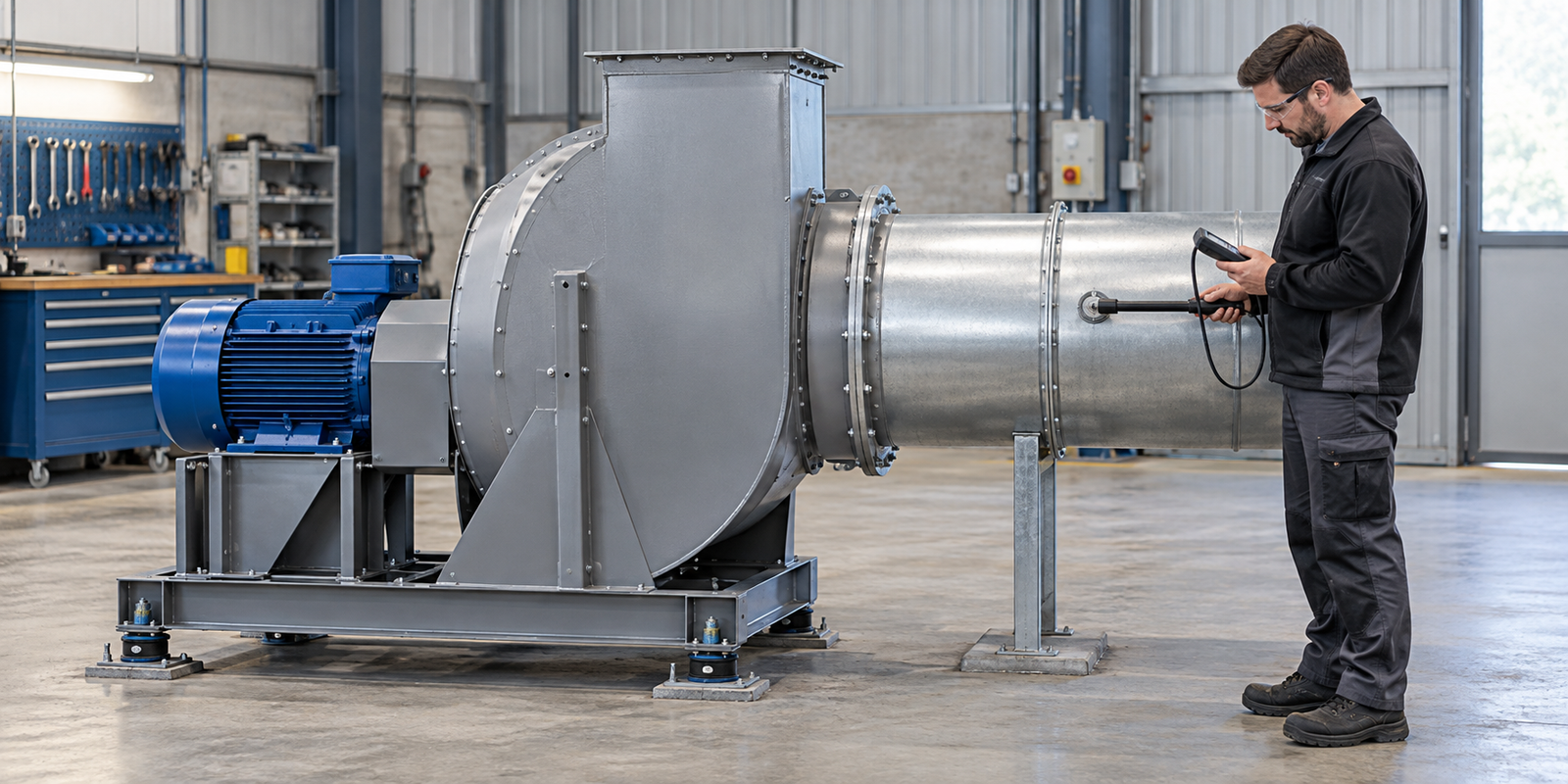
An industrial fan airflow measurement can show how much air a system is moving under the conditions observed during a site check. It can help compare current operation with a documented baseline or a design target. A single reading, however, does not by itself prove that a fan is correctly selected or identify the cause of low airflow. The measurement location, instrument, operating state, and recording method all matter.
Define the question before taking a reading
First decide what the check needs to answer. Are you comparing the system with its commissioning record, checking a change after maintenance, or investigating a process area that is not receiving enough air? Write down the target, the measurement point, and the equipment state. If the result will be used for acceptance, compliance, or a formal performance test, use the applicable test procedure and qualified personnel rather than an informal spot check.
Before measuring, record the fan configuration and the conditions that can affect the result: fan speed, damper position, filter condition, connected ductwork, air temperature, and the system’s operating mode. Note any recent changes. Keep the same settings when comparing readings so the comparison is meaningful.
Choose a suitable measurement point
Airflow in a duct may be uneven or swirling, especially near elbows, transitions, branches, dampers, or a fan outlet. A probe placed at one convenient point can therefore give a misleading picture of the average flow. A planned multi-point traverse across an appropriate duct section is generally more informative than a single-point reading, but the required method depends on the duct, access, instrument, and purpose of the test.
Record exactly where the measurement was made and how the probe was positioned. Avoid changing the setup between comparison measurements. If the available access point is close to a disturbance, note that limitation and treat the result accordingly rather than presenting it as a precise system airflow value.
Record the operating conditions and method
For each reading, keep the date, location, instrument type, units, fan speed if known, damper position, and relevant system conditions. If a handheld meter or pressure instrument is used, confirm it is suitable for the method and in service. Note the reading sequence and any unusual fluctuation. For a formal assessment, document instrument checks and uncertainty according to the chosen procedure.
Air velocity and volume flow are related, but they are not interchangeable: flow calculation uses the duct area and a representative average velocity. For non-uniform flow, the measurement method must account for conditions across the section. Do not convert one local velocity reading into a system airflow figure without stating the assumptions and method.
Interpret the result in context
Compare the result with a baseline or target only when the measurement points, units, fan speed, system settings, and air conditions are sufficiently comparable. A lower-than-expected reading is a reason to investigate, not a diagnosis. Check for changes in filters, dampers, duct restrictions, leakage, rotation, or drive conditions before concluding that the fan itself is the problem.
Airflow alone also cannot establish fan efficiency or confirm a duty point. A broader performance review may require pressure, speed, power, and air-density information collected using a consistent method. For background on relating system duty to fan performance, see how to read an industrial fan curve. You can also review the site’s centrifugal fan series and axial fan series when discussing equipment options.
Site-check checklist
- State the question, target, and point of measurement.
- Record fan speed, damper position, filter condition, and system mode.
- Describe the duct section and any nearby flow disturbances.
- Identify the instrument, units, probe position, and measurement method.
- Repeat or traverse as the selected method requires; note variation.
- Compare only with data collected under comparable conditions.
- Escalate formal acceptance or performance testing to qualified personnel.
Frequently asked questions
Can one handheld reading confirm a fan’s airflow?
Usually not by itself. A local reading may not represent the average velocity across the duct, and nearby fittings can disturb the flow. Use a suitable measurement method and document its limitations.
Why should I record fan speed and damper position?
They describe the operating state during the measurement. Without them, a later reading may not be comparable, even if it is taken at the same duct location.
Does a low airflow reading prove that the fan is undersized?
No. Filters, dampers, duct changes, leakage, fan speed, measurement setup, and other system conditions can affect the observed result. Check the full system before selecting a corrective action.
A useful site check makes its method and operating conditions clear. That gives maintenance and engineering teams a sound basis for deciding whether they need further system investigation or a formal fan performance assessment.