
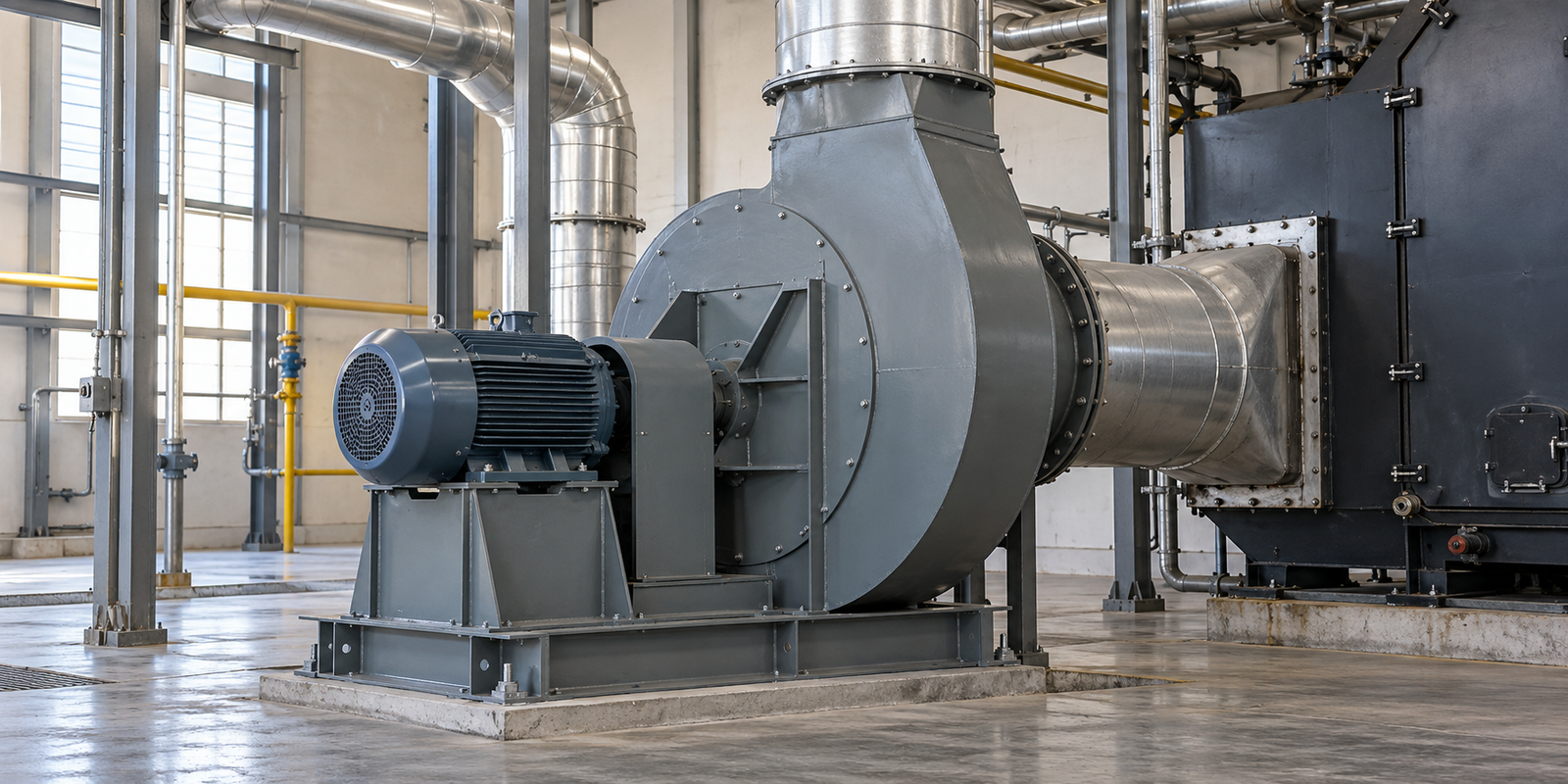
An induced draft fan for a boiler system draws flue gas through the boiler and toward the exhaust path, while a forced draft fan supplies combustion air toward the burner. These fans serve different sides of the gas path. Understanding where each sits helps engineers define the duty before discussing airflow, pressure, temperature, and construction.
What does a forced-draft fan do?
A forced-draft (FD) fan is generally on the combustion-air side, upstream of the burner. It pushes air into the combustion process and must overcome the resistance in its inlet, ductwork, burner equipment, and any other components in that supply path. The exact arrangement depends on the boiler design.
Because the FD fan supplies air under pressure, its operating point is affected by system restrictions and control settings. A damper position or speed change can alter airflow and pressure. For that reason, a fan name or motor rating alone is not enough to confirm whether it suits a particular boiler.
What does an induced-draft fan do?
An induced-draft (ID) fan is typically located on the flue-gas side. It draws gas through the boiler passages and the downstream path, which may include heat-recovery or gas-treatment equipment, and moves it toward the stack. By pulling from the furnace side, the ID fan helps maintain the pressure condition required by the system’s draft-control strategy.
The Y5-47 Boiler Centrifugal Fan on this site is described as an induced-draft fan for industrial and civil boiler systems. Its product information says the final model should be checked against required airflow, static pressure, medium, installation arrangement, and power supply. Available performance and construction details vary by model, so use the selected model’s current product data.
How the two duties differ
The simplest distinction is direction and location: an FD fan pushes combustion air toward the burner, while an ID fan pulls flue gas from the boiler toward the exhaust. They work within one connected draft system, so changing one fan or a system restriction can affect pressure and flow elsewhere. The required fan arrangement and control method depend on the boiler and process design; do not assume every installation uses the same layout.
Gas conditions also differ. Combustion-air and flue-gas duties may have different temperatures, dust loading, moisture, or corrosive components. These conditions can influence materials, clearances, sealing, drive arrangement, and maintenance needs. Confirm them for the actual operating case instead of selecting a fan from its application label alone.
Information to confirm before selecting a boiler fan
- Required duty: airflow and static pressure at the intended operating point, including the design load and relevant operating range.
- Gas or air conditions: medium, operating temperature, dust, humidity, oil or corrosive components, and any stated site restrictions.
- System resistance: duct length, elbows, dampers, boiler passages, filters, heat exchangers, and downstream equipment that contribute pressure loss.
- Installation details: fan position, mounting arrangement, inlet and outlet direction, available space, access, and connection dimensions.
- Power and controls: local voltage and frequency, motor arrangement, speed control, and how the fan operates during startup and load changes.
Then compare the required duty with the performance data for the selected fan model. A fan curve helps show how airflow and pressure relate across operating points; see the site’s guide to reading industrial fan curves. For boiler-specific models, review the High-Temperature & Boiler Fans section and confirm the actual conditions with the relevant product data.
Common selection mistakes
Common problems include confusing the combustion-air fan with the flue-gas fan, choosing by motor power without checking the duty point, and overlooking temperature or contaminants in the gas stream. Another mistake is to compare two fan readings while the boiler load, damper position, or downstream resistance has changed. Record the system conditions and compare like with like.
Frequently asked questions
Is an induced-draft fan the same as a forced-draft fan?
No. They operate on different sides of the boiler gas path: the forced-draft fan supplies combustion air, while the induced-draft fan draws flue gas toward the exhaust path.
Can I select a boiler fan using airflow alone?
No. Selection also depends on pressure, medium, temperature, system resistance, installation, and power requirements. Confirm the complete duty with the data for the intended fan model.
Does every boiler use both FD and ID fans?
Not necessarily. Draft arrangements vary with the boiler and process. Check the system design and identify the actual fan duty before specifying replacement or new equipment.
Correctly identifying the fan’s place in the boiler draft system gives the selection discussion a clear starting point. Use the required operating conditions and model-specific performance data to determine whether a candidate fan fits the application.