
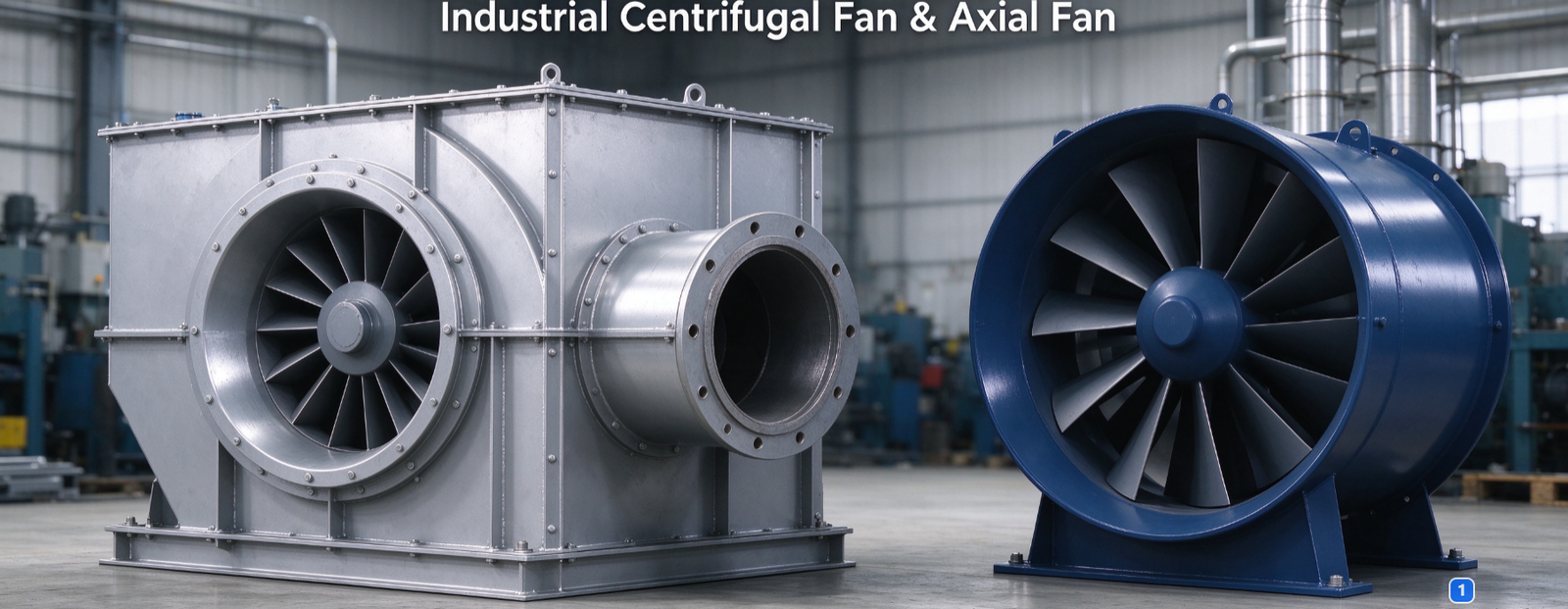
Industrial ventilation is critical for worker safety, temperature control, dust removal, fume exhaust, equipment cooling, and HVAC system efficiency. As an industrial fan manufacturer, Fan designs and supplies reliable industrial centrifugal fans and axial fans for factories, mines, tunnels, boiler rooms, paint booths, dust collection systems, and commercial ventilation projects.
Choosing the right fan depends on airflow, static pressure, duct resistance, installation space, and operating conditions. This guide helps you understand the differences between industrial centrifugal fans and axial fans, so you can select the best solution for your industrial ventilation system.
What Is a Axial Fan?
A axial fan moves air parallel to the impeller shaft. Air enters from one side and exits in the same axial direction, making it suitable for applications that require high airflow at relatively low static pressure.
Popula industrial axial fans are commonly used for general ventilation, heat dissipation, fresh air supply, and exhaust in spaces with short ducts or low resistance. Their compact structure and lightweight design make them easy to install on walls, ceilings, roofs, or duct sections.
Typical axial fan configurations include:
- Wall-mounted axial fans
- Ducted axial fans
- Roof axial exhaust fans
- Explosion-proof axial fans
- High-temperature axial fans
- Low-noise axial fans
Best applications for axial fans:
- Workshop ventilation and heat removal
- Warehouse and storage area cooling
- Tunnel and garage ventilation
- Greenhouse and livestock building air exchange
- Commercial HVAC fresh air systems
- Large airflow, low-resistance exhaust systems