
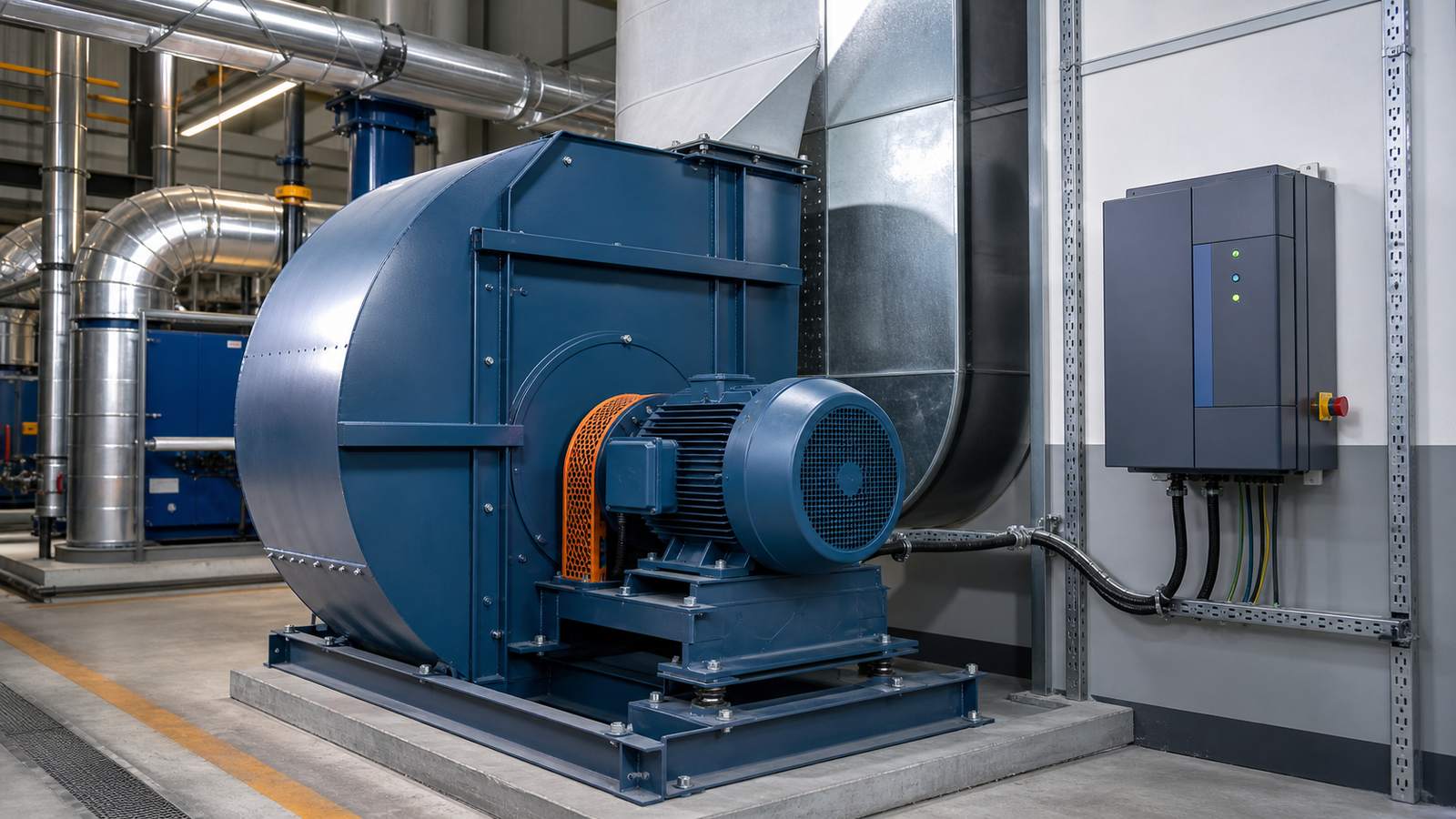
Industrial fan VFD selection is now included in the technical review support provided by HDFAN for ventilation, process-exhaust and dust-extraction projects. As the industrial fan brand of Hengshuangda, HDFAN helps purchasers define the fan duty, motor configuration and control requirements before a final model is confirmed.
Industrial fan VFD selection begins with the operating duty
A variable-frequency drive (VFD) can adjust fan speed to suit changing production, ventilation or process conditions. It can be useful where airflow demand changes between shifts, where a measured pressure must be maintained, or where the system is expected to operate at several defined duty points. However, the drive should not be selected from motor power alone. The required airflow, static pressure, air medium, operating temperature, duty variation and proposed control method should be reviewed together with the selected fan curve.
For centrifugal fans, changes in speed affect airflow, pressure and absorbed power differently. A lower speed can reduce airflow and pressure, while an increase in speed can raise the required motor power quickly. Confirming the intended operating range helps avoid an unsuitable drive rating or an operating point outside the fan’s recommended range. It also gives the project team a clearer basis for setting acceleration time, maximum frequency and protective limits.
Information reviewed for a VFD fan system
Effective industrial fan VFD selection needs information about both the fan and the air system. A catalogue model or motor rating is a useful starting point, but it does not fully define how the installed equipment will operate. HDFAN reviews the following project inputs before confirming the proposed configuration:
- Required airflow and static or total pressure at each operating condition
- Fan type, impeller arrangement, drive arrangement and proposed speed range
- Motor power, voltage, frequency, insulation class and efficiency requirements
- Air medium, temperature, dust, corrosive gas and hazardous-area considerations
- Control objective, such as manual speed adjustment, pressure control, airflow control or process interlock
- Installation layout, duct resistance changes, sensors, dampers and any existing control equipment
- Required operating hours, start-stop frequency and maintenance access conditions
Confirm the practical operating limits
The final speed range must consider fan stability, motor cooling, vibration, noise, belt-drive limitations where applicable, and the system resistance curve. A VFD does not remove the need to confirm these operating limits. It is also important to identify whether the fan will operate continuously at reduced speed, temporarily increase speed for a process condition, or work with dampers and other control devices.
At low speed, a standard motor may have reduced self-cooling. At high speed, the impeller, bearings, drive arrangement and absorbed power must remain within the approved limits. The selected control method should also be practical for the site. For example, a pressure-controlled system needs a suitable pressure sensing location; a poorly placed sensor can cause unnecessary speed changes or unstable control. Where multiple branches or filters affect resistance, the likely clean and dirty conditions should be identified during the review.
Electrical and export project requirements
For export projects, the electrical supply and control interface should be confirmed early. Nominal voltage, frequency, control signals, enclosure requirements, cable routing and local site standards can affect both the motor and VFD specification. Buyers should also advise whether the VFD will be supplied with the fan, installed by the customer, or integrated into a larger control panel. This helps define the responsibilities for wiring, communication signals, commissioning and site testing.
Support before production
HDFAN can review the application information with the buyer before production and confirm the appropriate fan series, motor arrangement and VFD-related project inputs. For an industrial fan VFD selection review, please provide the required duty point, operating conditions, power supply, expected speed range and control expectations. The proposed configuration can then be evaluated against the project requirements before production is released.
Contact HDFAN to discuss an industrial fan project with variable-speed operation.