
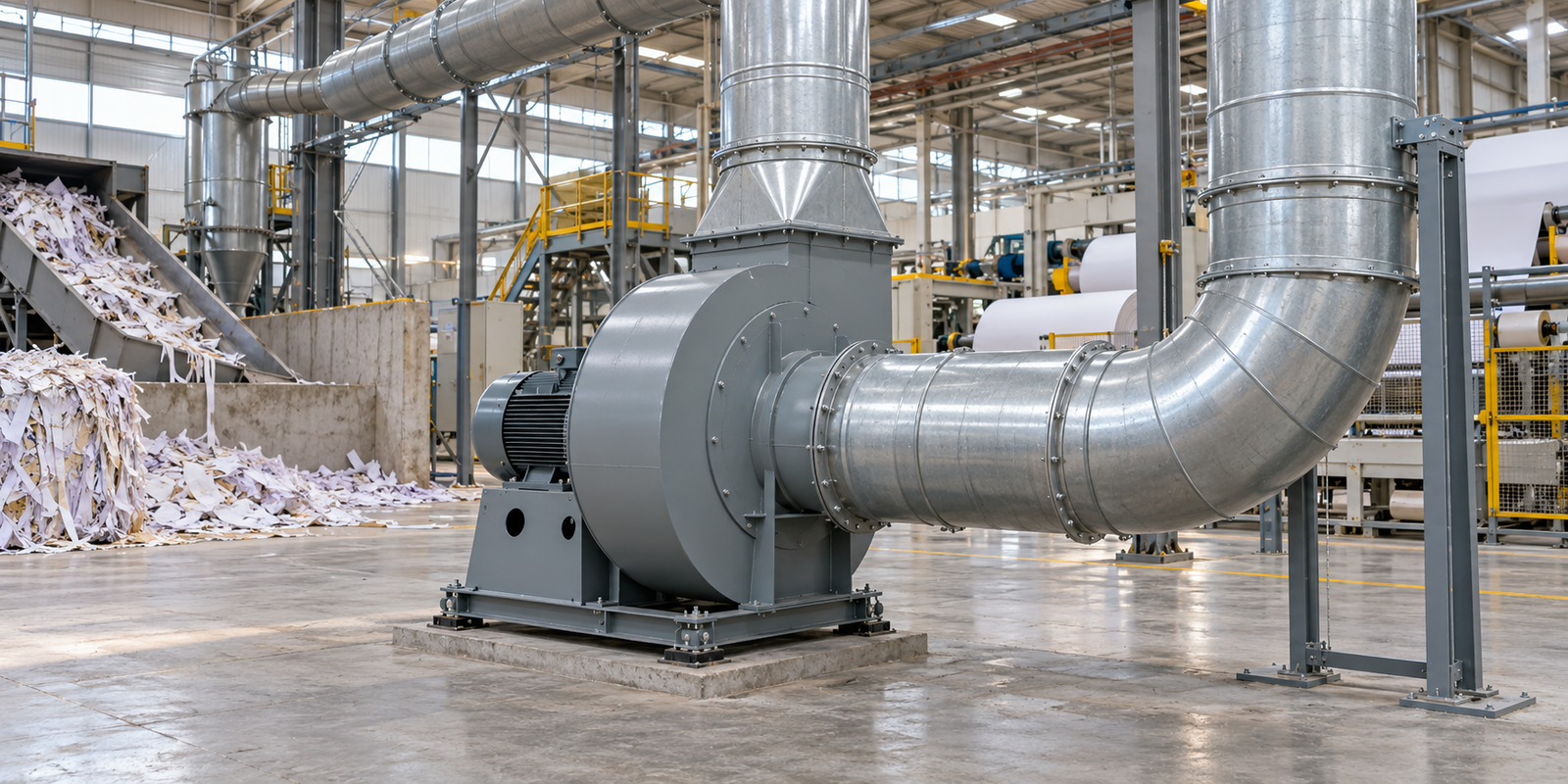
A scrap paper conveying fan must be selected for the material-handling system, not treated as a general room exhaust fan. Before comparing models, define what paper trim is being moved, how it enters the duct, the route to the collection point, and the airflow and pressure required at the fan. These details help confirm whether a model is suitable for the actual process.
How scrap-paper conveying differs from room ventilation
Room ventilation moves air through an occupied or production space. Scrap-paper conveying moves air that carries paper trim through a pickup and duct route to a collection point. The fan’s duty therefore depends on both the air system and the material stream. A fan that appears adequate by free-air capacity alone may not meet the system duty after duct, fittings, and collection equipment are included.
The JQZ scrap-paper delivery fan is described on this site for collecting and conveying paper trim and air containing paper scraps. Its published page also makes clear that available construction and performance details vary by model, so the project conditions should be checked against the selected model.
Record the material and process conditions
Start with the material being collected. Note the paper type, trim shape and size, whether the material is dry or damp, and whether it may include dust, adhesive, coating, or other contaminants. If the material loading varies during production, describe the expected range and when peaks occur. Do not assume that different paper scraps behave identically in a conveying line.
Describe the process sequence as well: pickup points, branches, any separator or collector, discharge destination, and whether the line runs continuously or in batches. A simple process sketch can reveal where the fan sits relative to the material stream and where access for inspection or clearing is needed.
Define airflow, pressure, and the duct route
Provide the required airflow and the pressure duty at the fan, with units and a clear statement of whether the pressure is static or total. Include the duct diameter, approximate lengths, elbows, transitions, branches, dampers, filters, separators, and outlet arrangement. These components affect resistance and can shift the operating point.
Do not select a fan from a maximum airflow number alone. The required flow and pressure must be considered together on the relevant fan performance data. Conveying velocity should be determined for the material and process by the responsible system designer; a general ventilation rule of thumb is not a substitute for that check. The site guide on duct resistance and fan selection explains why the installed route matters to fan duty.
Check installation and operating limits
Before model confirmation, state the operating temperature, electrical supply, installation arrangement, available space, and expected operating hours. Identify any abrasion, moisture, corrosion, or unusual site restrictions that could affect the fan construction. Confirm that the layout allows safe inspection of the fan, duct, and collection equipment.
Keep the fan, ductwork, pickup points, and collection equipment in the same review. A change to a branch, filter, or discharge route can change the system resistance. If the final layout changes after selection, the required duty should be reviewed again rather than assuming the original model will operate at the same point.
What to send for a model review
- Paper type, trim dimensions or description, moisture, and any known contaminants
- Required airflow and pressure, with units and pressure basis
- A duct sketch showing lengths, fittings, branches, pickup points, and collection equipment
- Operating temperature, electrical supply, installation arrangement, and operating schedule
- Any abrasion, corrosion, access, noise, or site constraints that need consideration
Use the Dust Collection & Material Transport product catalog to review related site products, then provide the operating information for a model-specific check.
Frequently asked questions
Can a standard exhaust fan convey scrap paper?
That cannot be decided from the label alone. Confirm whether the fan is intended for the material stream, and check its duty, construction, and operating limits against the process.
Why is the duct route needed for selection?
Duct length, elbows, branches, transitions, filters, and collection equipment contribute resistance. The fan must be reviewed at the duty created by the complete installed system.
What information is most useful if the final airflow is not known?
Send the process description, pickup arrangement, duct sketch, material details, collection method, and site conditions. A qualified system designer can then establish the required operating point before model confirmation.